
Finding Lancaster Resident Records
A name alone is rarely enough to identify a Lancaster resident. Start with the record tied to the question. The County Property Tax Inquiry can connect a name or site address to an assessed parcel owner. The Recorder can confirm a recorded transfer. A historical household is more likely to appear in the digitized city directories, census material, or an archive request. Each source answers a different question, so an address, a date, and a second matching detail are more useful than repeated name searches.
Property ownership, a postal mailing address, and present occupancy are separate facts. The County’s assessment product records assessed ownership and property data. It does not certify that all, or any, people living at a site are shown there. Lancaster’s public resources also omit protected, sealed, confidential, and otherwise nonpublic information.
- Search the Lancaster County Property Tax Inquiry by owner, parcel, or site address and note the account number, municipality, and assessed-owner information.
- Use the parcel or deed reference in LanCo View 2.0 to confirm the land being researched.
- Check the Recorder’s document index for the named party role and document reference.
- For an earlier household, search the Lancaster City and County directory collection and compare neighboring volumes or census years.
- When no online index covers the identified record, send the custodian a narrow request with the name, timeframe, record type, and any reference number.
Note: Preserve the parcel, document, or book-and-page reference with each result so a later check does not depend on a name alone.
Lancaster Resident Record Custodians
Lancaster is the county seat, but the offices do not hold interchangeable files. The Recorder of Deeds maintains recorded land instruments. The Office of Assessment maintains the current property-tax inquiry. The Register of Wills / Clerk of Orphans’ Court handles estates, guardianships, inheritance tax, adoptions, and marriage licensing. The Prothonotary keeps civil filings, while the Clerk of Courts keeps Common Pleas criminal and juvenile filings. The County Archives is the older-record fallback.
Recorder of Deeds
Recorded land and document custodian
Public hours: 8:30 a.m.-5 p.m.
Use the Recorder’s official contact route
County Archives
150 N. Queen St., tower basement
Lancaster, PA 17603
717-299-8319
The office distinction matters most when a search result raises a question rather than proving an answer. For a named street’s current address trail, use the focused Lancaster by-street directory workflow.
Lancaster Parcel Records by Address
The free wEdge Property Tax Inquiry is Lancaster County’s current parcel route. Basic search accepts an account number of up to 13 characters. Advanced search can use owner name, house-number low and high fields, street name, municipality, property class, land use, sale price, sale date, year built, and square footage. It does not publish a ZIP filter. Select a Lancaster City ward or annex code when that is known, because a Lancaster mailing address can be outside the City.
| Property field | Useful Lancaster check |
|---|---|
| Owner Name | Find an assessed owner, then confirm the site and parcel. |
| House Number and Street | Search a site or a short address range. |
| Township/Municipality | Choose City Wards 1-9 or the listed City annex codes when applicable. |
| Sale Date and Price | Use as a clue, then verify with the recorded instrument. |
The County Property Tax Inquiry screen shows the address and owner-oriented search path used for Lancaster parcel research.
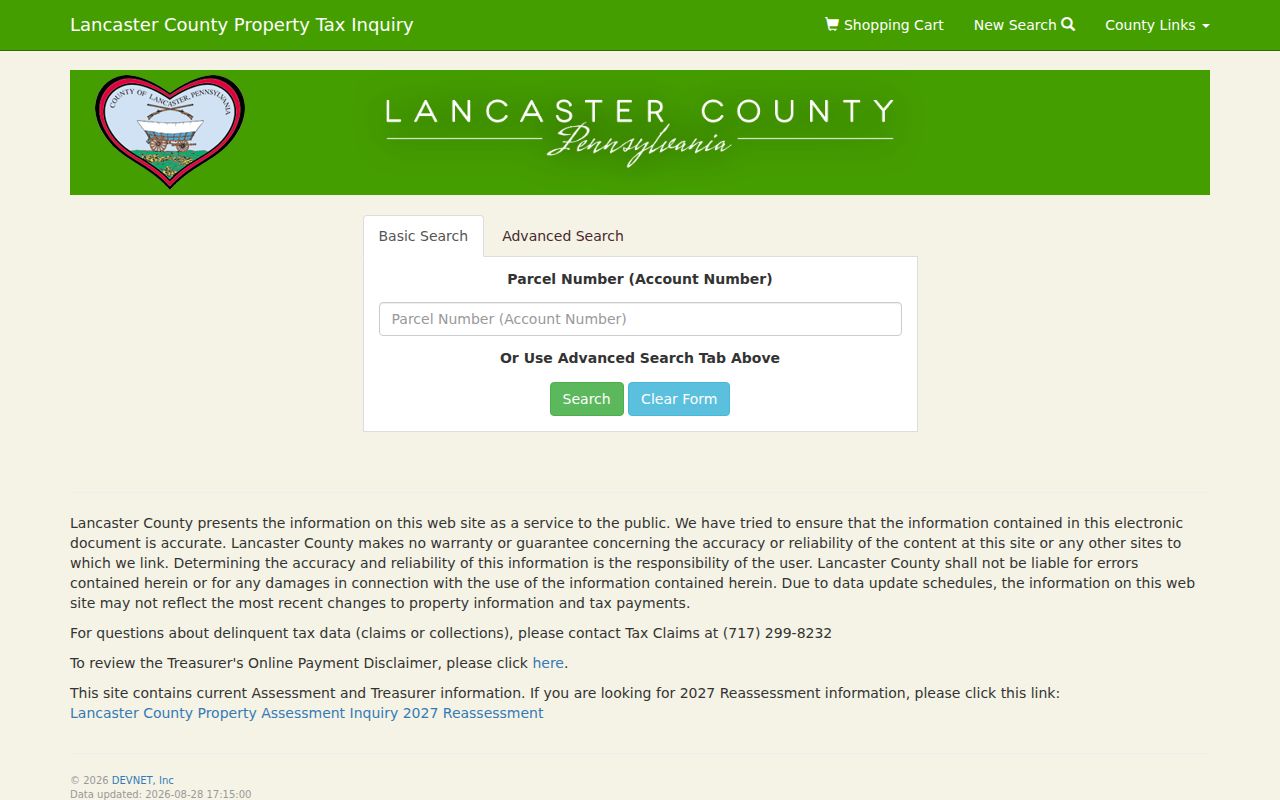
Use the returned account or parcel as a reference, not a claim about a household.
Lancaster Deed Index Timeframes
Deed research in Lancaster has a clear handoff between systems. The Recorder’s web search reaches deeds recorded from 1981 forward. Recorder microfilm covers deed books from 1808 through 1980. County Archives keeps deeds and indexes from 1729, and LancasterHistory holds grantor/grantee index microfilm from 1729 through 1894 with deed-book runs identified in its collections. A blank web search is therefore not the end of a property trail.
The Recorder’s terms screen treats the index as a finding aid. Search by both names, grantor, grantee, recording date, document number, book and page, municipality, parcel, or document type. Individual-name help uses a last-name-first form and encourages reasonable spelling variations. Record the party role and document reference before drawing conclusions.
The Recorder Document Search and Copies interface is the modern entry point for the Lancaster deed index.
A document number or book-and-page reference makes an archive or counter request much more precise.
Lancaster Voter Status and Lists
Pennsylvania’s Find Voter Registration Status tool is a self-status lookup. It is not a public street browser. A public, street, walking, or full voter list follows a different process under 25 Pa.C.S. §§1207 and 1404: the requester uses the official form, supplies identification and a use affirmation, and the research identifies a $20 list charge. Lancaster County Voter Registration can explain which request route applies to a particular city or county list.
The state tool illustrates the status-check channel, while the request process governs larger lists.
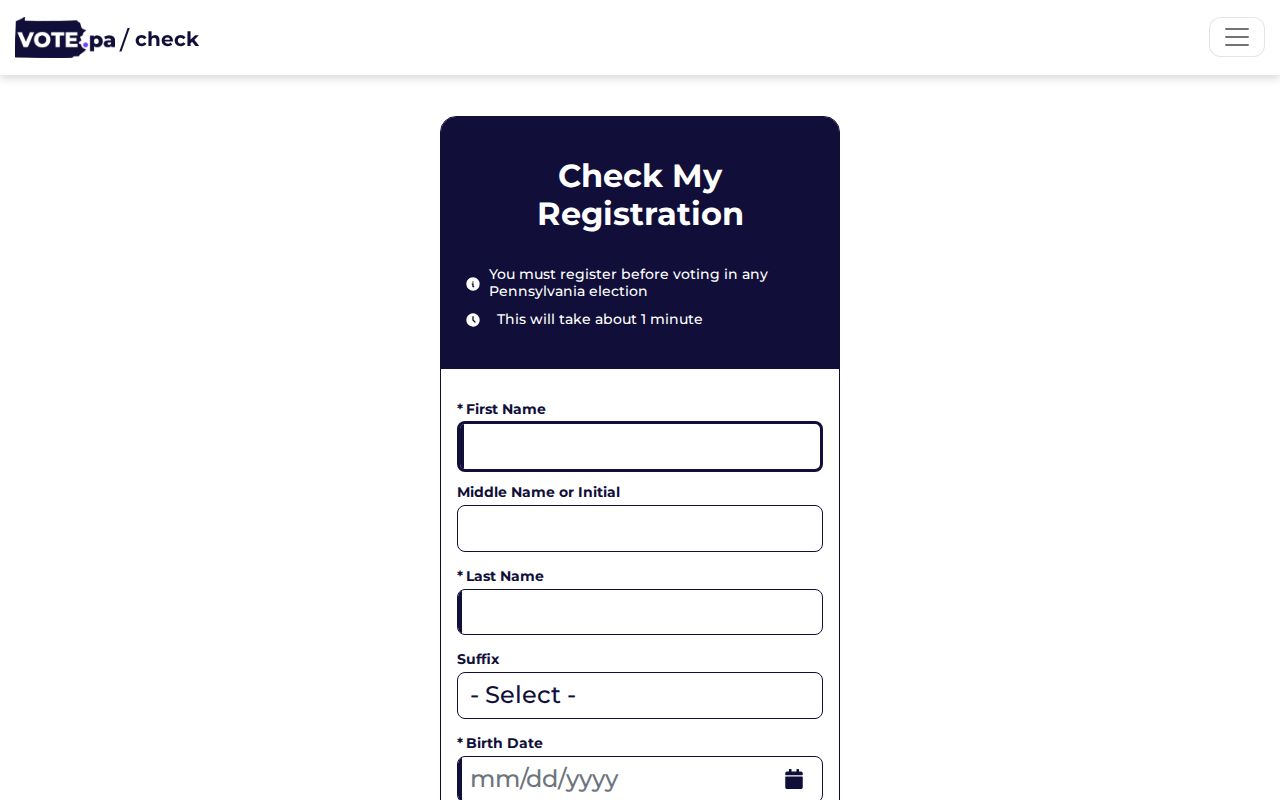
Registration status is administrative and time-sensitive; it is not a statement about where a person physically stays.
Note: Voter records can be updated for moves, deaths, confirmations, or changes to a voter’s name, address, or party.
Lancaster Court Docket Matches
UJS Case Search is the free statewide starting point for publicly released docket sheets and calendars, including Lancaster County. Start with a participant last name and County, then add only the fields needed to separate similar names. The interface offers docket and participant controls, filing-date range, County, judicial district, court office, participant role, case type, status, parcel, address, city, state, and ZIP criteria in the applicable search modes.
Dockets can show public parties, events, status, category, court, and published financial entries. They do not substitute for an identity check or a criminal-history record. Juvenile, expunged, limited-access, and some protected civil material is not public. The local Prothonotary, Clerk of Courts, and court office remain the routes to underlying files when access is permitted.
The Pennsylvania UJS search screen provides Lancaster County filters and advanced criteria.
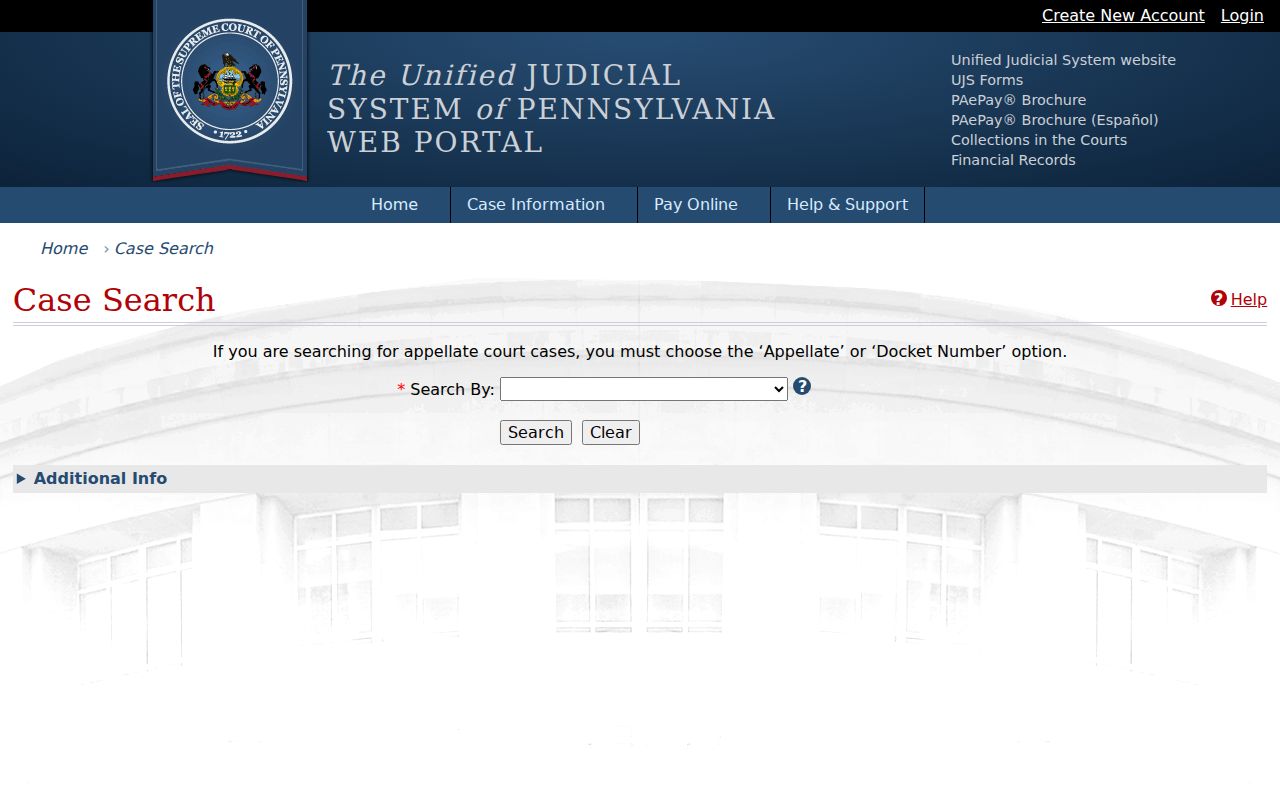
Use the lightest name-plus-county search first, then compare a returned docket with independent record details.
Current Lancaster Resident Sources
Lancaster does not publish one current resident roll. Instead, each official source records a limited relationship: an assessed owner, a party to a recorded document, a voter using the official request channel, or a party in a publicly released docket. These are useful leads when their limits are kept in view. A historical directory can show a past occupancy, but it is not a modern household list.
| Lancaster source | What it can support | Custodian | Access route |
|---|---|---|---|
| Property Tax Inquiry | Assessed owner, parcel, situs, and related assessment details | County Assessment | Free web search |
| Recorder document index | Named parties and references in recorded instruments | Recorder of Deeds | Terms-gated web index and counter |
| Voter list request | Statutorily released list fields | County Elections / Commonwealth | Official request and use affirmation |
| UJS Case Search | Public docket participants and event information | Pennsylvania judiciary | Free public portal |
| County Prison search | Current County-custody lookup within that system’s scope | Lancaster County Prison | Public search with phone fallback |
For a one-person question, the Lancaster resident lookup sequence explains how to compare these record types without mistaking one result for full proof.
Lancaster Vital Record Routes
Birth and death certificates from 1906 forward are Pennsylvania Division of Vital Records records, not a general public name-search system. Certified copies have eligibility, identification, and fee rules. The State Archives offers the historical path once a birth record is 105 years old or a death record is 50 years old. Lancaster marriage licenses are held through the Register of Wills, and divorce files are routed through the Court of Common Pleas.
Lancaster County Archives and LancasterHistory help with local older material. Their scope includes county and court records, historic government documents, deeds, wills, and identified obituaries. A targeted email or mail request should state the name, timeframe, record type, and context. Archives staff check available indexes for stated timeframes but do not perform broad research.
Lancaster License and Claim Leads
A state professional or occupational record can confirm a reported license status or discipline history, not a home address. Pennsylvania’s PALS includes person, facility, disciplinary, and provider search modes across 29 boards and commissions. The Department notes that changes can take up to 48 hours to appear. Pennsylvania Treasury’s unclaimed-property service is another name-led official channel, but a result is a lead to a claimant process rather than proof of identity.
The PALS landing page shows the distinct search modes available for license verification.
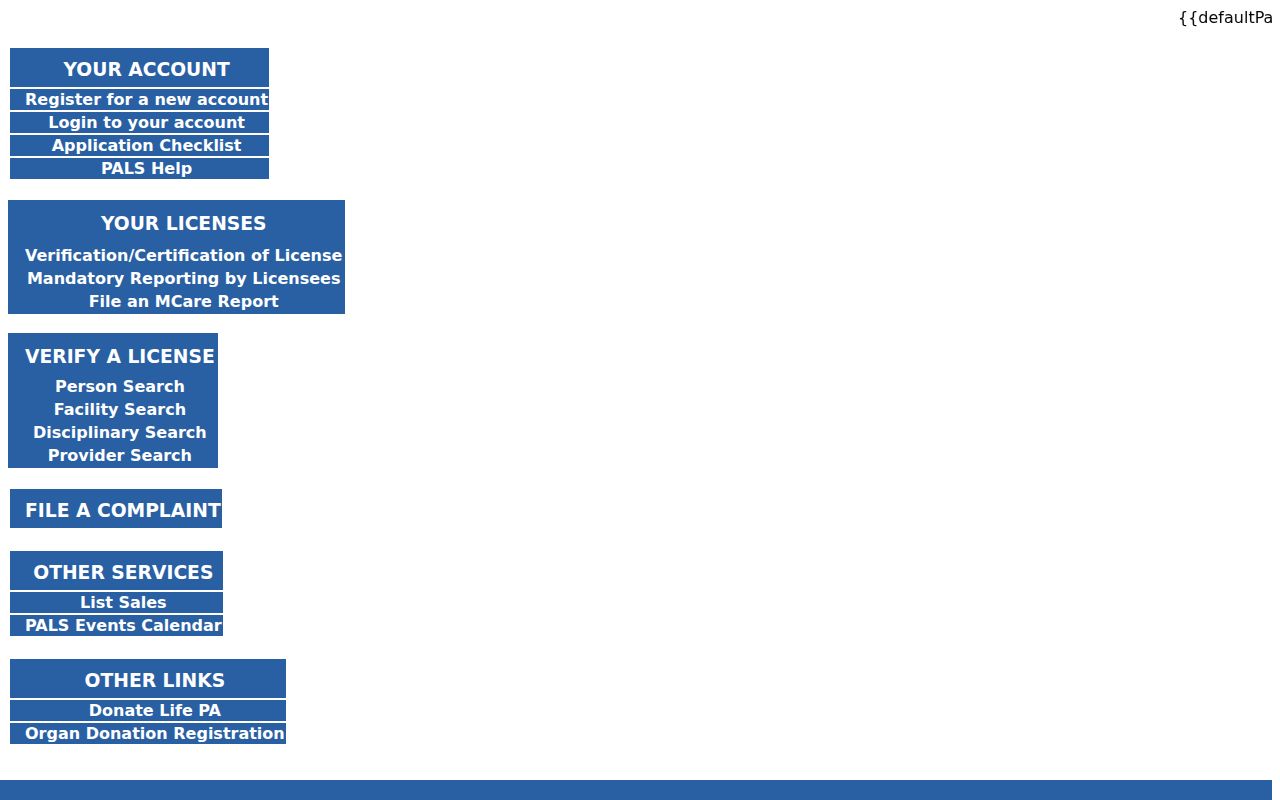
When a listed field matters, compare it with the issuing board’s current information.
The Pennsylvania Treasury unclaimed-property search is a public name lookup with an optional account for searching.
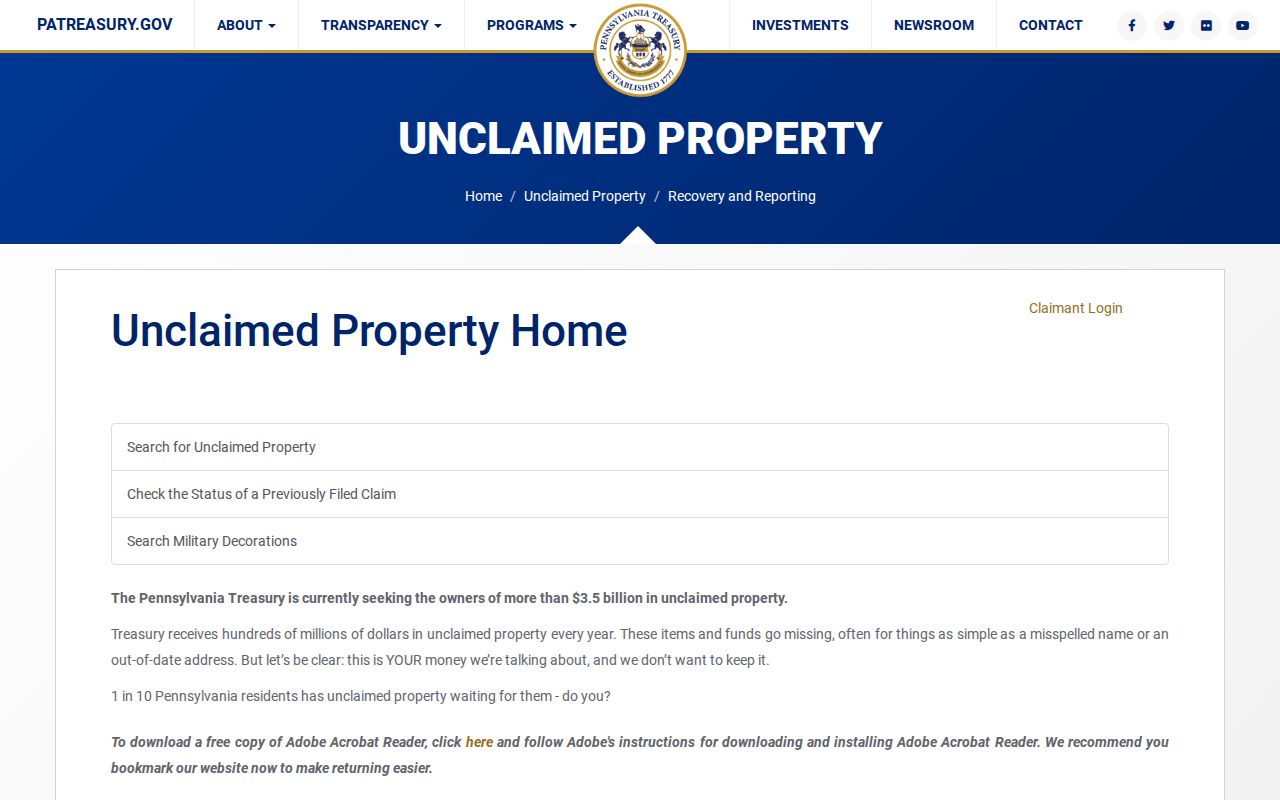
Misspelled names and outdated addresses can cause property to become unclaimed, so Treasury requires evidence through its claim route.
Lancaster Records Request Channels
When a defined City record is not online, the City’s Right-to-Know portal is the route to request an existing document. The request should identify the record with a date range, subject, author, title, or other search aid. Lancaster does not accept anonymous or verbal Right-to-Know requests. The City ordinarily responds in five business days or invokes a stated 30-calendar-day extension. Electronic records are supplied when practicable; paper copies are $0.25 per page and prepayment may apply above $100.
For County government records, use the County open-records contact. Court administrative records follow the court’s Rule 509 request process, not the ordinary RTKL channel. The Pennsylvania Right-to-Know Law, 65 P.S. §§67.101–67.3104, allows an appeal of a denial or deemed denial to the Office of Open Records within 15 business days. Court confidentiality rules still control protected judicial material.
Lancaster Privacy Boundaries
Some absences from a Lancaster search are deliberate. Driver information is limited by the federal Driver’s Privacy Protection Act. Vital records have date-based confidentiality. Voter-file use has statutory limits and is not for open internet publication. UJS removes juvenile, expunged, and limited-access matters from public access. A missing result is not evidence that a person has no record or no connection to Lancaster.
Pennsylvania’s Address Confidentiality Program lets qualifying survivors use a substitute mailing address for many state and local record systems. It is administered by the Office of Victim Advocate, requires renewal every three years, and is not a public-address workaround. Use all record channels for lawful, personal research and never to stalk, harass, or harm anyone.
Lancaster Record Scam Checks
Records can help verify a claim, but they also appear in impersonation and deed-fraud schemes. The Lancaster County Sheriff warns that callers can clone its number and impersonate deputies. The Sheriff does not call or email to demand online or telephone payment, gift cards, or payment for court costs, bail, fines, or missed jury duty. Verify a demand by independently calling the Sheriff at 717-299-8200 during weekday office hours or by contacting local police.
The Pennsylvania Attorney General’s February 2026 deed-fraud warning advises against rushing to sign an unexpected deed, title, refinance, or tax proposal. Preserve the notice, check the deed through the Recorder, contact a lender through independently found information, and use the Attorney General’s official complaint channel where appropriate. Treasury likewise says it does not send unsolicited texts about unclaimed property.
Lancaster Historical Resident Directories
LancasterHistory links to searchable and browsable Lancaster City & County Directories covering 1843 through 1922, split into 1843-1900, 1901-1914, and 1914-1922 digital groups. The Lancaster Public Library supplies City directories, local newspapers, census microfilm from 1790 through 1930, maps, and yearbooks. Directory entries are evidence of historical occupancy, not title. Early volumes may use a corner description rather than a numbered address, so maps and nearby street entries help bridge the old grid to a later address.
- Index
- A finding tool that points to a document or entry; it is not the underlying record.
- Parcel
- The account or mapped unit used to identify a specific property in assessment and GIS work.
- Criss-cross directory
- A directory arranged around addresses or streets, useful alongside the alphabetical name listing.
- Situs address
- The physical location of the property, which can differ from an owner’s correspondence address.
The full collection runs, entry conventions, and household-tracing method are set out in the Lancaster City Directories section. Pair an entry with a deed or tax record before describing a person as an owner.
Note: Search adjacent directory years and reasonable spelling variations because a single volume can omit, misspell, or describe an address differently.