
Lancaster City Directory Collections
Lancaster’s best documented directory run is the digitized Lancaster City & County Directories collection. It covers 1843 through 1922 and is divided into 1843-1900, 1901-1914, and 1914-1922 groupings that can be browsed or searched. That online run is the first stop for a surname, a business address, or a former household. It is not the only local shelf. Lancaster Public Library retains city-directory microfilm alongside newspapers and local census microfilm, while LancasterHistory adds related maps, manuscripts, photographs, church material, and government records.
| Collection | Years | Where Held | Access |
|---|---|---|---|
| Lancaster City & County Directories | 1843-1922 | POWERLibrary via LancasterHistory | Browse or search online in three date groups |
| Lancaster City Directories | Years not itemized online | Lancaster Public Library local history | In-person microfilm |
| Lancaster County census microfilm | 1790-1930 | Lancaster Public Library | Local historical research |
| Public and print yearbooks | Turn of the twentieth century to runs through 1988 | Library and POWERLibrary | Print holdings and searchable public-domain volumes |
The library has not published a complete later directory run, so a missing later volume should not be treated as proof that publication ended. Use the verified 1843-1922 digital span as a firm date range, then ask the local-history desk whether its microfilm fills the particular year needed. Directories show historical listings, not a complete present-day household.
The collection also has useful companions that answer different parts of a Lancaster question. The local library’s census microfilm can place names in a household, and its selected church and cemetery material may add a relationship or death context. Yearbooks can place a person in a school-era record. LancasterHistory’s manuscript, photograph, and map collections can supply place and family context. None replaces the directory entry, but each can test whether the name, address, and time period belong together.
Searchable Lancaster City Directories, 1843 to 1922
The three online date groupings make it practical to follow one spelling across a long period. Start with the surname, record the volume year, and then look for a street-based cross-reference. Early volumes may describe a corner rather than give a numbered address. The City’s house-history guide notes that the directories are arranged by street address and cross-referenced by last name, so both routes matter when names are common or spelling shifts.
The LancasterHistory research page identifies the City and County directory collection and its related archival material.
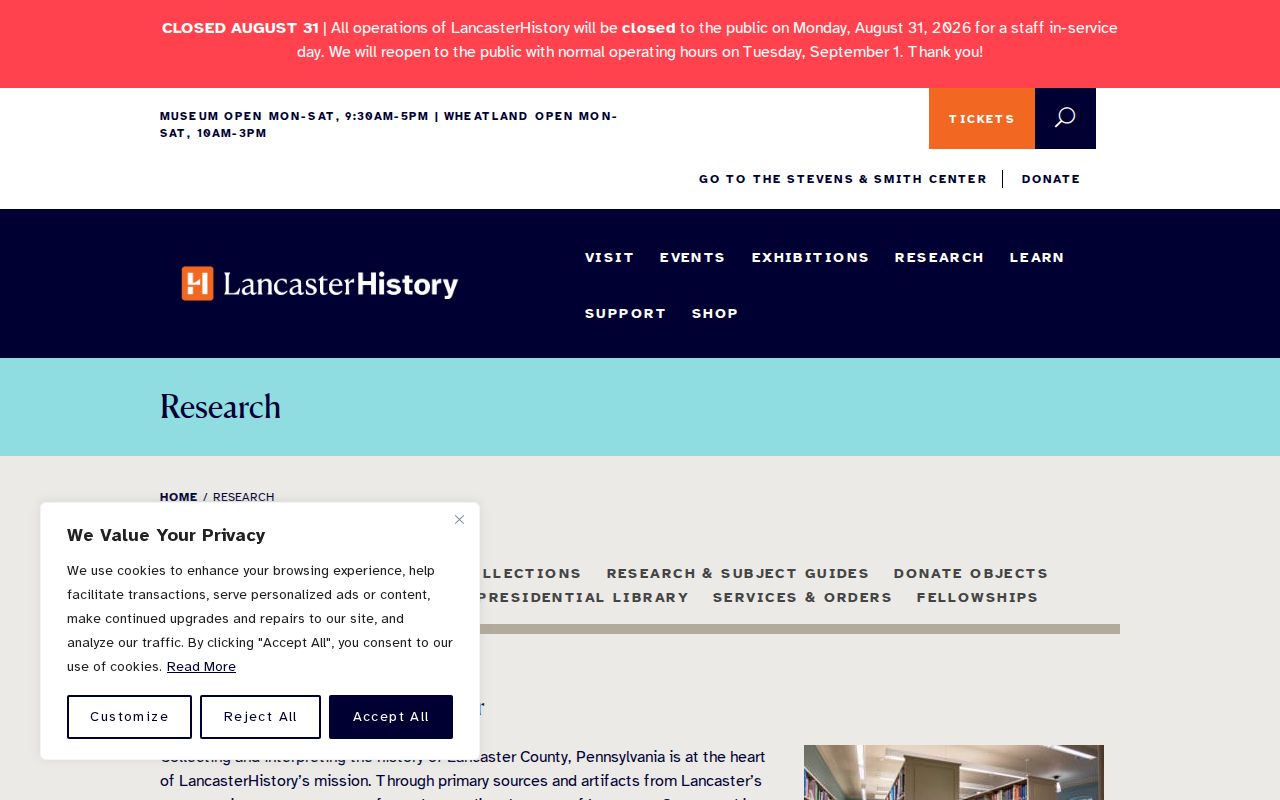
The research center is the physical fallback when a digital listing needs a map, manuscript, newspaper, or staff-assisted collection check.
Do not assume that the same convention appears in every book. The local research specifically warns that exact abbreviations, spouse notation, owner symbols, and employer conventions were not verified across all years. Inspect the prefatory key in the target volume before assigning meaning to a mark. Try omitted or transposed vowels, surname variants, and adjacent alphabetic pages before concluding that a person is absent.
Note: A directory’s online search result is a starting point; retain the volume year and page context when comparing it with another source.
Reading a Lancaster City Directory Entry
A directory entry is strongest as occupancy evidence. It commonly puts a name near a residence or street description and may add an occupation or business location. That association can help distinguish people with the same surname, especially when it matches a map, census, deed, or notice. It does not establish title to the property. Compare an occupant listing with the Recorder’s deed chain before calling the listed person an owner.
| Name | An alphabetical surname entry; retain the exact spelling shown in that volume. |
|---|---|
| Address or corner | The core locating field. Early books can identify a corner instead of a house number. |
| Occupation or business reference | A corroborating detail that may help separate similarly named people. |
| Street cross-reference | A second route to the address when the volume provides street arrangement. |
| Vacancy indication | Later directories may flag a property as vacant, a useful clue between listings. |
- Street listing
- A directory arrangement that groups entries by street or location rather than surname, when provided in the volume.
- Householder index
- An alphabetical route to a named listing. It is useful beside a street cross-reference but may reflect the spelling used by that edition.
- Abbreviation key
- The explanatory page, often near the front of a volume, that should be checked before interpreting a printed mark or shortened term.
Lancaster Library and Research Center
Lancaster Public Library’s local-history collection provides city directories, selected newspapers on paper or microfilm, census microfilm from 1790 through 1930, atlases, local histories, selected church and cemetery records, passenger lists, family histories, and yearbooks. Its yearbook holdings include more than 400 print volumes from more than 35 area schools. Searchable and browsable public-domain yearbooks in POWERLibrary can supplement a directory trail, including identified Hempfield, McCaskey, and Lancaster Catholic runs through 1988.
The Public Library local-history page describes the microfilm, directory, and yearbook resources available to researchers.
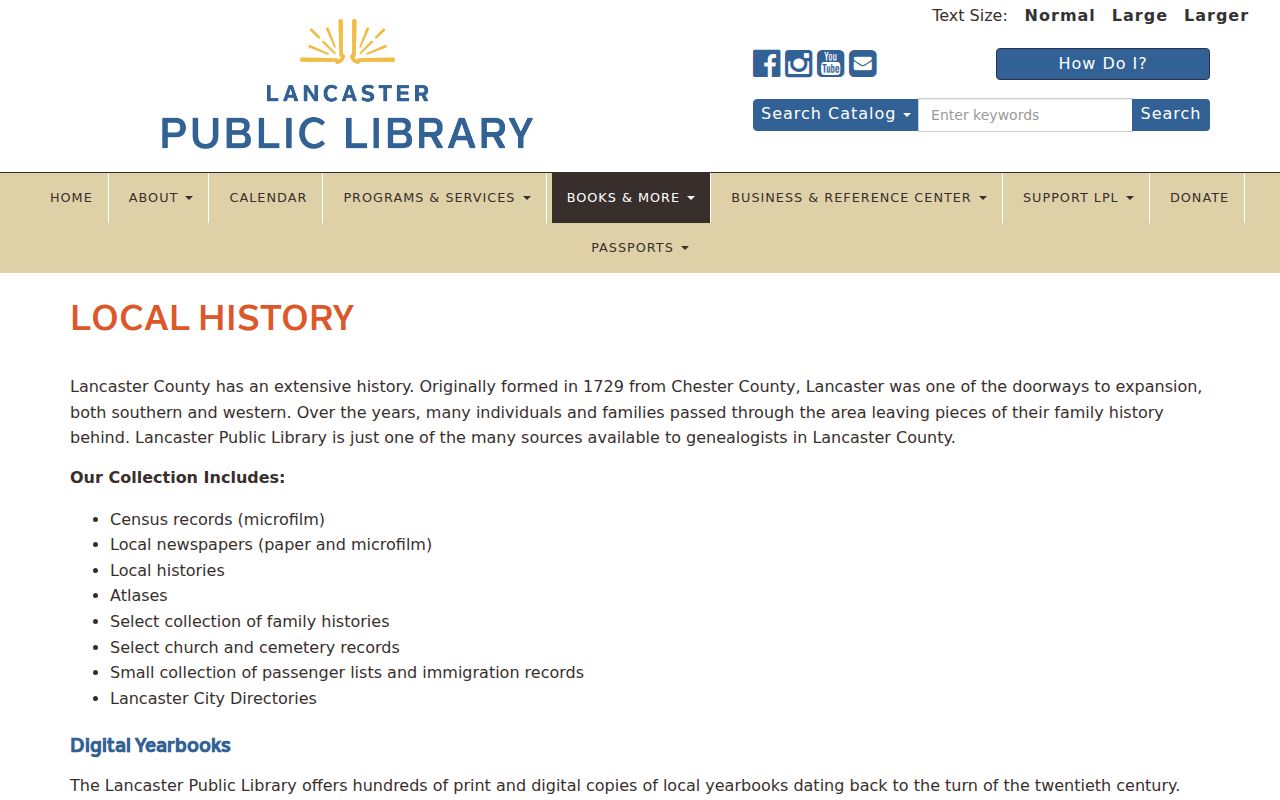
Library microfilm and yearbooks give a useful second check when a digitized Lancaster city directory entry is incomplete or unclear.
For a deeper archival visit, LancasterHistory’s Research Center is at 230 N. President Ave., Lancaster, PA 17603. It holds 16,000 library volumes and more than 600 manuscript groups spanning 1729 to the present. Research hours are Wednesday through Friday and the first Saturday of each month, 9:30 a.m. to 2 p.m. The center encourages a reserved time slot and a pre-visit email to research@lancasterhistory.org; its research line is 717-392-4633 ext. 126. Search the catalogue and collection database first, then bring titles, references, and dates.
Lancaster Maps Resolve Corner Addresses
Corner descriptions are not dead ends. LancasterHistory holds a local map and atlas ladder that can bridge an early corner listing to a later number. The documented sequence includes Joshua Scott’s 1842 county map, T. J. Kennedy’s 1858 City map, the 1864 Bridgens Atlas, Roe and Colby’s 1874 City map, the 1875 Everts and Stewart Atlas, the 1886 Baist City atlas, and Graves and Steinbarger surveys from 1899. Sanborn fire-insurance maps are also in the collections.
Maps can show a building’s first appearance, local street context, and in some atlases block-level owner names. They also help separate a replacement building from the one named in an old deed. Lancaster’s 1730 grid and Hamilton lots make lot lines, alleys, bounding streets, and surrounding addresses especially useful when an early directory has no modern number.
- Copy the directory’s spelling, year, street or corner, and any nearby names.
- Check the map nearest that date for the corner, lot, alley, and surrounding streets.
- Compare a later directory or census entry after the location is identified.
- Use a deed reference only when the question is ownership rather than occupancy.
Note: No verified City-wide street-renumbering date was located in the reviewed sources, so do not assume a modern number existed in an early volume.
Lancaster Newspapers Extend Directory Trails
Once a surname, address, or deed date is established, newspapers can add a dated event. LancasterHistory lists digitized runs of the Lancaster Examiner & Herald from 1834-1872, Columbia Spy from 1830-1889, Intelligencer Journal from 1848-1871, New Holland Clarion from 1873-1950, and Lancaster Farmer from 1869-1884. Search the narrow fact already found rather than an open-ended family name. An obituary, estate notice, sale notice, fire report, or business advertisement can corroborate a move or a date.
Directories, newspaper notices, and maps answer different questions. A directory can place a person at a location. A newspaper can document an event. A map can show the block or structure. For property title, turn to the Recorder and historical deed sources rather than trying to make a directory carry that proof.
Trace a Lancaster City Directory Household
A careful household trail uses adjacent years instead of a single hit. Begin with the later known name or address, then move backward volume by volume. Record the exact printed form of the name, the address format, any occupation clue, the street listing, and nearby entries. When the listing disappears, a move, death, omission, vacancy, or changed spelling may explain it. The answer needs confirmation from the next source, not a guess.
- Locate the person in a dated directory and save the year, page, spelling, and address form.
- Check the street material for nearby listings and a second address route.
- Search at least the adjacent directory years, trying spelling variants before treating the household as gone.
- Pair the nearest directory year with census material, which can add names, ages, birthplaces, relationships, and an own-or-rent indication.
- Use a deed, tax record, obituary, probate file, or newspaper notice only for the next question the directory leaves open.
Census records are a useful companion, not an automatic correction. Enumerators made errors, and the census date may not match the directory year. Lancaster Public Library and LancasterHistory report access to census material from 1790 through 1930, while detailed federal schedules generally become public after 72 years.
Lancaster Archive Requests Need Specifics
A remote historical request works best when it names the person, place, date range, record type, and any object identifier or catalogue reference. LancasterHistory can supply selected historical government documents and obituaries as copies or PDFs. Its listed scope includes deeds from 1729 into the 1860s, obituaries from 1798 to the present when a date of death is known, Orphans’ Court material from 1742-1867, wills from 1730-1908, probate from 1729-1913, and older court and commissioner records.
The listed document-request price is $5 per document, plus 6% Pennsylvania sales tax for Pennsylvania residents. Check the current process before ordering, since collection systems and digitization routes change. LancasterHistory reports that its databases are being improved while digitization continues, so verify a catalogue reference if an older saved link no longer opens.